
Commercial Solar in Connecticut in 2026
Connecticut Eversource and United Illuminating commercial rates are the second-highest in the continental US, creating an exceptional financial case for commercial solar. The Connecticut C-PACE program (Commercial Property Assessed Clean Energy) allows property owners to finance solar through property tax assessments at below-market interest rates over 25 years — an alternative to the ESP model for businesses that prefer not to use tax-based financing. Both utilities offer retail-rate net metering for commercial systems up to 2 MW. See DSIRE Connecticut for all current programs.
Connecticut Solar Incentives 2026
- Federal ITC (30-50%): Base 30% plus applicable adders through Dec 31, 2027
- C-PACE Financing (CT Green Bank): Property-assessed clean energy financing at below-market rates, repaid through property tax — 25-year term available
- Eversource/UI Net Metering: Retail-rate credit for excess solar generation for systems up to 2 MW
- Sales Tax Exemption: Solar equipment exempt from CT sales tax
- Municipal Property Tax Exemptions: Many CT municipalities offer solar property tax relief
- MACRS 5-Year Depreciation: Federal accelerated depreciation on ITC-adjusted basis
- SolarEdge 2030 Safe Harbor (Network-Exclusive): Connecticut projects reserved through our installer network can lock in federal ITC eligibility through December 31, 2030 — bypassing the standard December 31, 2027 cutoff that applies to developers outside this network
The SolarEdge Safe Harbor: Connecticut ITC Access Through 2030
The federal construction-start safe harbor deadline (July 4, 2026) has passed, and most developers are now racing to place projects in service by December 31, 2027 — the standard cutoff — or risk losing the ITC entirely. Our select installer network isn't on that clock. Through a pre-negotiated, physically verified equipment reservation with SolarEdge, our partners secured safe-harbored access to the federal Investment Tax Credit for qualifying Connecticut projects completed by December 31, 2030 — a three-year extension unavailable to developers outside this network.
Deloitte independently reviewed the strategy: its team toured SolarEdge's manufacturing facility, met with SolarEdge leadership in Tampa, FL, and issued a memo confirming that projects built on this reserved-inverter methodology qualify for ITC treatment. SolarEdge has committed gigawatt-scale production capacity to this arrangement, with roughly 200 MW currently allocated to partner networks nationwide. Fewer than 10 installer networks in the US hold a direct reservation of this kind.
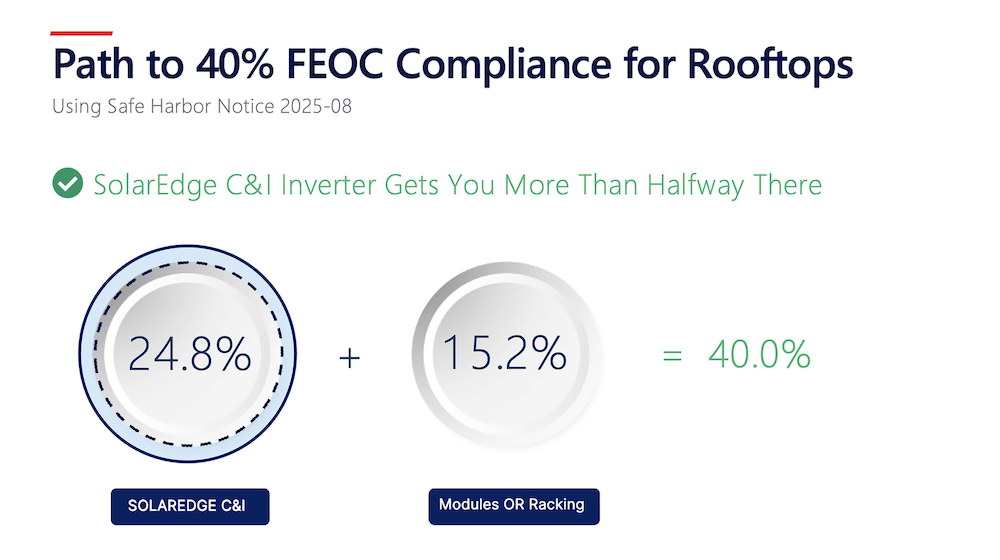
Official SolarEdge equipment pathway to 40% FEOC compliance under IRS Safe Harbor Notice 2025-08

How to Get Started With Connecticut Commercial Solar
The fastest path to locking in incentives is requesting a proposal now. Our team verifies ITC eligibility, checks energy community adder status, identifies applicable state programs, and connects you with a vetted Connecticut EPC. The December 31, 2027 ITC in-service deadline makes timeline certainty critical — starting the proposal and interconnection process now is essential. For more on financing, see our ESP zero cap-ex program guide and commercial solar financing comparison. For tax strategy, see our MACRS depreciation guide and 2026 tax incentives overview.
Nearby States We Serve
New York, Massachusetts, Rhode Island, New Jersey, and Pennsylvania. View our full US service area.