Why Illinois Businesses Are Going Solar in 2026
Illinois is one of the strongest commercial solar markets in the Midwest, driven by a uniquely deep incentive stack that combines federal tax credits with state SREC income, utility cash rebates, and a property tax freeze. For manufacturers, distributors, apartment owners, and auto dealerships paying significant electricity bills to ComEd or Ameren, the ESP model consistently produces day-one positive cash flow with zero upfront capital.
Our Illinois installations are completed by Solar One Illinois, based in Northbrook and serving businesses across the entire state. Solar One has completed 40+ commercial projects ranging from 100 kW neighborhood installations to 1.63 MW manufacturing arrays. Every project uses vetted equipment, carries NABCEP-certified design, and is managed through permitting, interconnection, and commissioning by Solar One's full EPC team.
The most important deadline for Illinois businesses is the December 31, 2027 ITC in-service deadline. Projects beginning construction today must be commissioned by that date to qualify for the 30-50% federal Investment Tax Credit. Our team verifies energy community eligibility, manages interconnection timelines, and coordinates with ComEd's distributed generation program or Ameren Illinois renewable energy programs to keep projects on schedule.
Illinois Solar Incentive Stack 2026
No other Midwest state combines as many stackable incentive layers as Illinois. The result is that qualifying businesses using our ESP model often see federal and state subsidies fund the entire system cost, with positive cash flow starting in month one.
- Federal ITC (30-50%, Section 48E): Base 30% investment tax credit, with up to 10% energy community adder and 10% domestic content adder for FEOC-compliant equipment
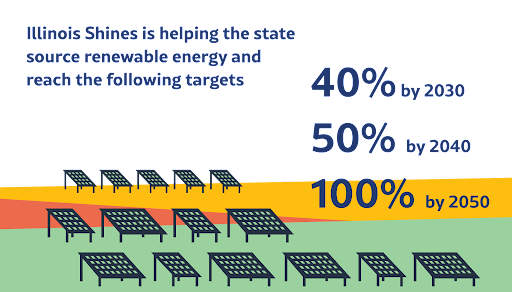
- Illinois Shines SREC Program: 15-year Adjustable Block contracts paying for solar renewable energy credits based on system production — adds $8,000-$25,000+ annually for mid-size commercial systems
- ComEd Smart Inverter Rebate ($250/kW): Cash rebate for commercial systems up to 2,000 kW using qualifying smart inverters — up to $500,000 for larger installations
- MACRS 5-Year Depreciation: Accelerated federal depreciation reduces taxable income by 50%+ of system cost in the first two years
- Illinois Property Tax Assessment Freeze: Solar installations are exempt from property tax increases under the Illinois Revenue Department's commercial solar exemption
- Sales Tax Exemption: Solar equipment qualifies for Illinois sales tax exemption on qualifying purchases
ComEd vs. Ameren: Illinois Utility Landscape
ComEd serves northern Illinois and the Chicago metro area (Cook, DuPage, Lake, Kane, McHenry, and Will counties), covering the densest commercial solar market in the state. Ameren Illinois serves central and southern portions of the state including Champaign-Urbana, Peoria, Springfield, and the Metro East region near St. Louis.
Both utilities operate commercial net metering programs under Illinois Public Utilities Act requirements, crediting excess solar generation at the retail rate. ComEd interconnection timelines typically run 60-90 days for systems under 500 kW. Ameren interconnection often runs longer — 90-150 days — making early project initiation essential for downstate businesses targeting the 2027 deadline. Our team files interconnection applications as early as possible to protect timeline. You can track ComEd interconnection queue status at the ComEd Distributed Generation portal.
Illinois Commercial Solar by Property Type
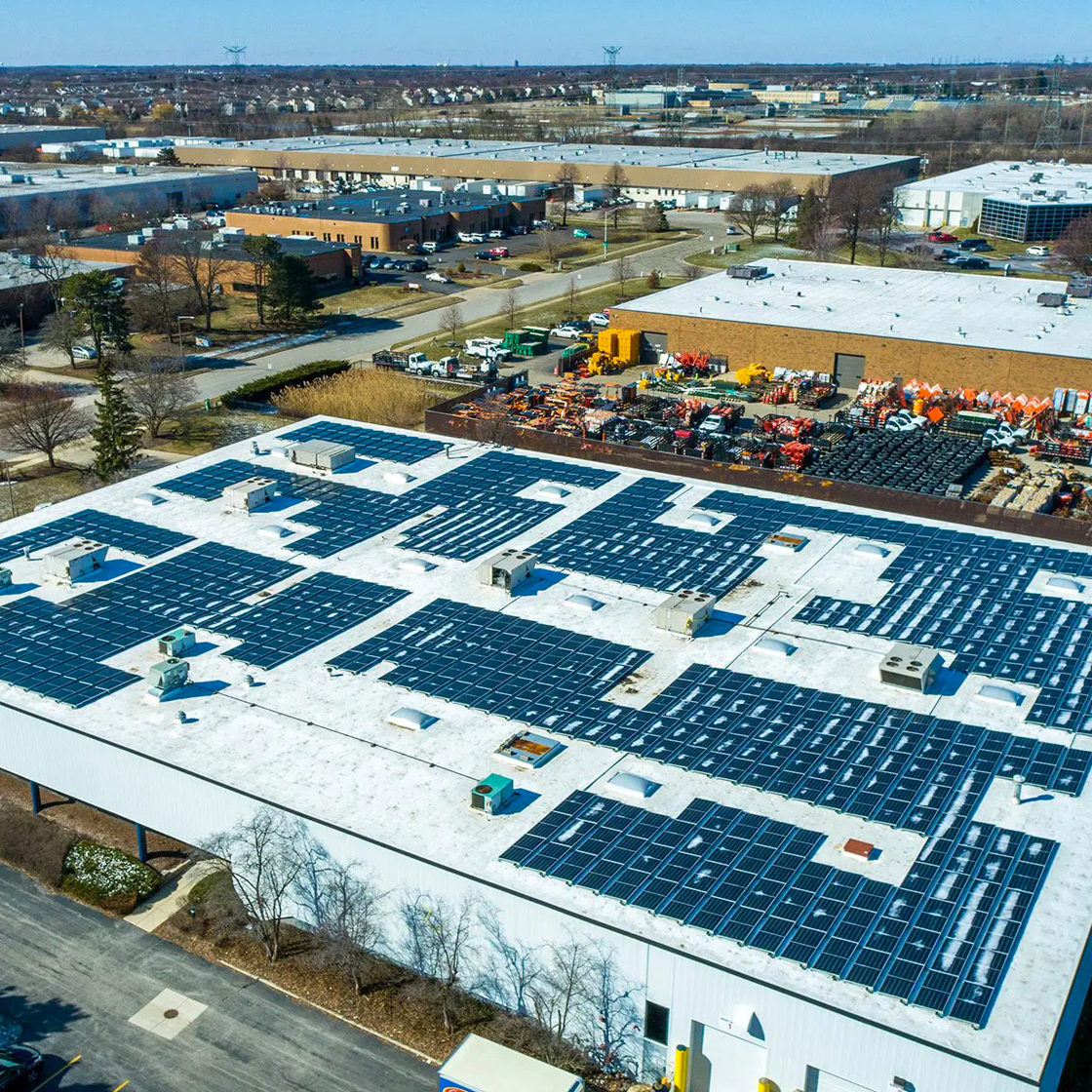
Illinois commercial solar has been adopted across virtually every property category. Manufacturing facilities and distribution centers produce the strongest ROI because of their combination of large flat roofs, high daytime electricity consumption, and federal tax liability that powers the ESP model. The I-88 tech and industrial corridor from Aurora through Naperville, the Route 53 industrial parks in Glendale Heights and Carol Stream, and the I-55 logistics corridor south of Chicago have all seen significant commercial solar deployment.
Auto dealerships have been another standout sector — see our Arlington Toyota case study for a documented Illinois example. Multi-family apartment complexes, school districts, and nonprofits leveraging the ITC Direct Pay provision round out the active Illinois markets. If your facility uses significant electricity during daylight hours and carries federal tax liability, the Illinois incentive stack likely makes a compelling case for solar.
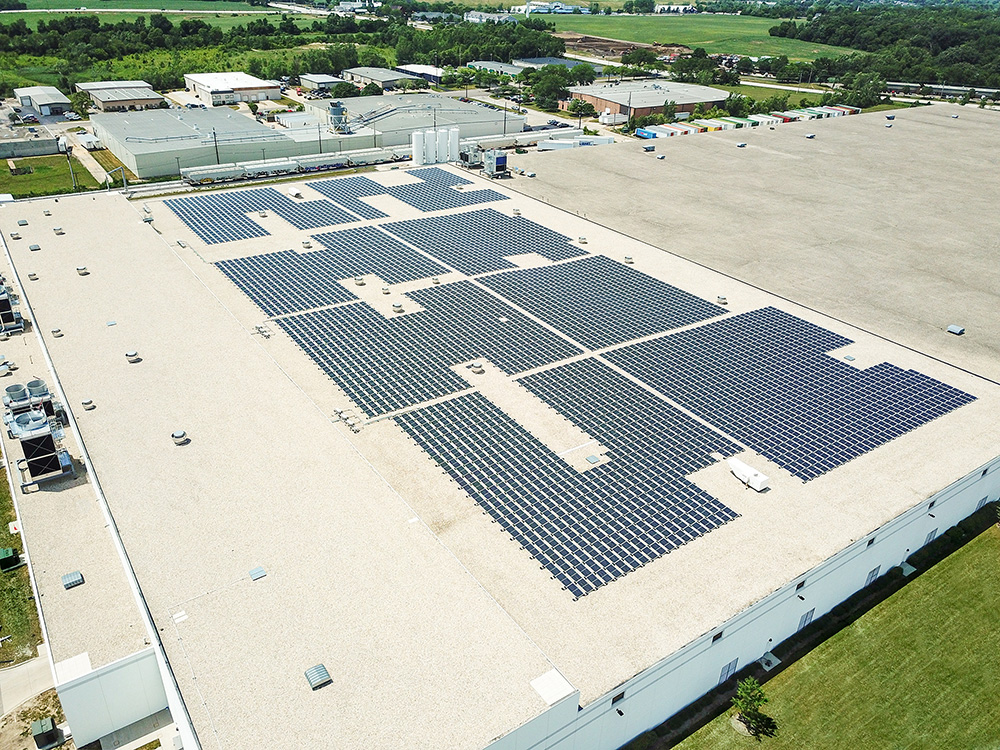
Midwest Plastics Manufacturer: 1.63 MW, $175k Annual Savings
The Situation
A Batavia manufacturer paying six figures annually to ComEd engaged us in 2020. Large flat roof, significant tax liability, and solar-ready structure after a 2019 re-roofing project.
Our Approach
Solar One Illinois designed a 1.63 MW array, coordinated a six-week ComEd interconnection study, and financed the full project under the ESP model using the federal ITC and ComEd Smart Inverter Rebate.
The Outcome
Permission to Operate in June 2021. $175,000 in annual savings from day one. Net first-year benefit $53,000 after ESP payments. 25-year total: $4.3 million projected.
Client name changed. Results vary. Prior results do not guarantee similar outcomes. Read the full case study →
Frequently Asked Questions: Illinois Commercial Solar
Related Illinois Solar Resources
Learn more about financing options, tax strategy, and how Illinois compares to neighboring states: