
Commercial Solar in Georgia in 2026
Georgia Power commercial rates have risen alongside the state's industrial expansion. For manufacturing, logistics, and distribution operations along the I-85 corridor, I-75 manufacturing belt, and Port of Savannah corridor, commercial solar reduces a meaningful operating cost without capital outlay under our ESP model. Our Georgia EPC partners are active in Atlanta, Savannah, Augusta, and Macon markets. See DSIRE Georgia for all current incentive listings and the Georgia Power commercial solar program for utility interconnection details.
Georgia Solar Incentives 2026
- Federal ITC (30-50%): Base 30% plus 10% energy community adder in qualifying rural Georgia coal-transition counties
- Georgia Property Tax Exemption: Solar systems exempt from ad valorem property taxes statewide
- Georgia Power Net Metering: Advanced Solar Initiative compensates excess generation at avoided cost rates
- MACRS 5-Year Depreciation: Federal accelerated depreciation on ITC-adjusted basis
- SolarEdge 2030 Safe Harbor (Network-Exclusive): Georgia projects reserved through our installer network can lock in federal ITC eligibility through December 31, 2030 — bypassing the standard December 31, 2027 cutoff that applies to developers outside this network
The SolarEdge Safe Harbor: Georgia ITC Access Through 2030
The federal construction-start safe harbor deadline (July 4, 2026) has passed, and most developers are now racing to place projects in service by December 31, 2027 — the standard cutoff — or risk losing the ITC entirely. Our select installer network isn't on that clock. Through a pre-negotiated, physically verified equipment reservation with SolarEdge, our partners secured safe-harbored access to the federal Investment Tax Credit for qualifying Georgia projects completed by December 31, 2030 — a three-year extension unavailable to developers outside this network.
Deloitte independently reviewed the strategy: its team toured SolarEdge's manufacturing facility, met with SolarEdge leadership in Tampa, FL, and issued a memo confirming that projects built on this reserved-inverter methodology qualify for ITC treatment. SolarEdge has committed gigawatt-scale production capacity to this arrangement, with roughly 200 MW currently allocated to partner networks nationwide. Fewer than 10 installer networks in the US hold a direct reservation of this kind.
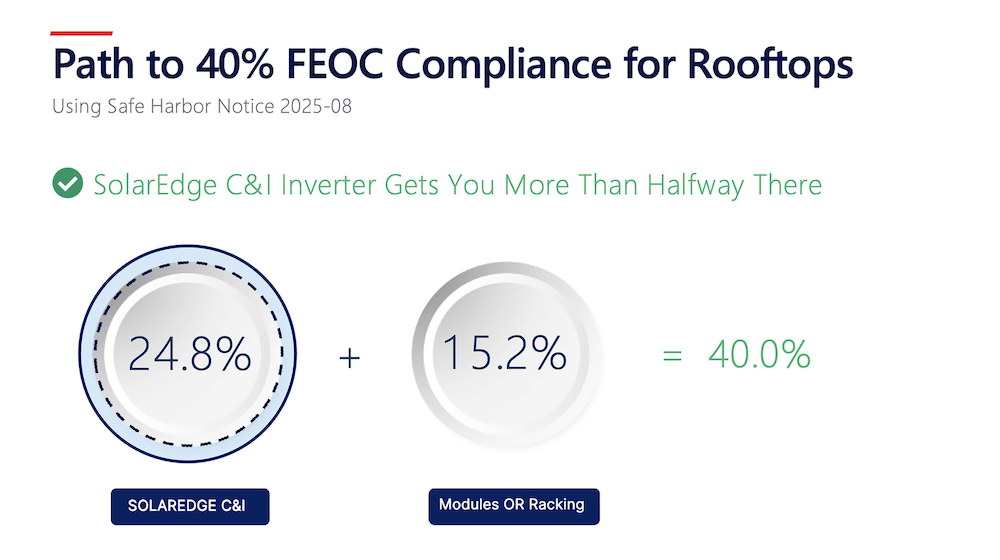
Official SolarEdge equipment pathway to 40% FEOC compliance under IRS Safe Harbor Notice 2025-08

How to Get Started With Georgia Commercial Solar
The fastest path to locking in incentives is requesting a proposal now. Our team verifies ITC eligibility, checks energy community adder status, identifies applicable state programs, and connects you with a vetted Georgia EPC. The December 31, 2027 ITC in-service deadline makes timeline certainty critical — starting the proposal and interconnection process now is essential. For more on financing, see our ESP zero cap-ex program guide and commercial solar financing comparison. For tax strategy, see our MACRS depreciation guide and 2026 tax incentives overview.
Nearby States We Serve
Florida, North Carolina, South Carolina, Tennessee, and Alabama. View our full US service area.